About the book
What separates constructive religious impulses from destructive ones? How does someone who begins by contemplating his relationship with God end by committing an act of murder? Some argue that religiously motivated evil always represents a corruption of true religion. Others are quick to suggest that religion itself―all religion―is the root of extremist violence.
This is the first book to journey to the heart of religious militancy. Dr. Neil J. Kressel, who has spent decades researching genocide, terrorism, and anti-Semitism, brings to bear the insights of psychology and social science on this significant and critical problem. For those tired of simplistic bromides and obfuscating talk about the causes of religious terrorism, Kressel offers a clear and enlightening analysis of when and how religions become capable of inspiring evil. Specifically, he addresses the following key issues:
- Are some religions, religious doctrines, and religious practices more apt to inspire hatred and extremism than others?
- Are people who commit evil acts in the name of their faith always corrupting the true message of religion and, if so, what is that message?
- Do other members of the same faith bear any responsibility for misdeeds carried out in the name of their religion?
- Which sorts of people are most prone to extremism?
- Which types of societies are most likely to become breeding grounds for extremists?
- Can (or should) anything be done to combat the various forms of religious extremism?
- What limits, if any, can (or should) be placed on religious practice in America and elsewhere?
Beyond analyzing the nature of religious militancy, Kressel offers sensible recommendations for addressing what is to date the 21st century’s most serious challenge.
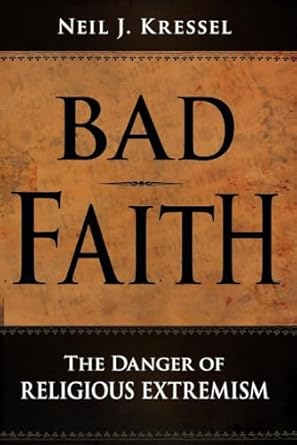
Book Details
HARDCOVER
978-1591025030
EBOOK
978-1615922611
Buy the book
ONE OF THE 50 BEST BOOKS ON TERRORISM
Perspectives on Terrorism
RECOMMENDED BOOK OF THE MONTH
ReligiousTolerance.org
What people are saying
“Refreshingly unique, this work probes differences among religious traditions openly and without the restraints of political correctness, proving to be the single best way to understand the authentic nature of religious extremism. . . Highly recommended.”
Choice Magazine
“The threat radical Islamists pose is not merely terrorist warfare but religiocultural warfare as well. This is directed against Western values as well as mainstream Muslim tendencies. Salafi Islam, their primary religious identity, is anti-modern and nihilistic (which is why they turn to terrorist tactics to strike at their adversaries), so it is important to understand why their adherents opt for a violent form of religious extremism rather than more constructive and progressive religious ideologies. . . .[Neil J. Kressel] incisively addresses these issues. . . . All those in the counterterrorism community who wish to understand and respond to the characteristics of religious extremism will greatly benefit from reading Mr. Kressel’s important book.”
Joshua Sinai, Counterterrorism expert, The Washington Times
“[A] very timely book indeed.”
Alan Caruba, Bookviews
“Finally someone has it right – that someone is Neil Kressel. . . . This is an important and well-researched book – a thinking person’s guide to a religious life devoid of violence.”
Steven K. Baum, Journal of Hate Studies
“. . . well-written and thoroughly researched. . .”
Monstersandcritics.com
“With Bad Faith, Kressel has made an interesting and informative contribution to an area of current affairs which is too often overshadowed by emotive work by writers with an agenda. This book will prove to be invaluable to anyone who is attempting to understand religious extremism in whatever form or manner.”
David Selwyn Caspar, University of Reading, UK, Comparative Strategy
“Reading Neil Kressel’s Bad Faith . . . is like taking a college-level course from a gifted teacher whose topic, religious extremism and its sometimes violent expression, compels rapt attention. “
Rebecca Kaplan Boroson, Editor, The Jewish Standard
“[T]he information presented through the course of this book is both interesting and useful. It’s definitely worth reading if you are interested in religious terrorism and extremist religious beliefs.”
Austin Cline, About.com: Agnosticism/Atheism
“. . . a very good book.”
Maphead’s Book Blog
“This book sparked my interest so much that I read it 3 times. Each time, the book held my attention fresh so that I didn’t put it down until I got to the end. Its topic is timeless and urgent and the dilemma is big. Religion and religious violence have been with humans as long as there have been humans and this book rightly takes head-on that violent religious extremism that is the great challenge of the 21st century. It does a superbly honest, careful, and accurate job. Bad Faith is full of sobering accounts of historical and contemporary acts of violence in the name of Christianity, Judaism, and Islam. The religious justification of violent acts and the accounts of killers in every faith are fairly and even handedly presented. Very happily, the author avoids the simplistic; suggestions are realistic, sensible, and doable. Briefly said, this book is excellent.”
Raymond F. Paloutzian, author of Invitation to the Psychology of Religion; editor of The International Journal for the Psychology of Religion
“This well written, engaging and compelling book addresses the great, current danger of religious extremism, especially in Islam. It shows that religiously motivated violence has been part of all three great religions and that the sacred texts of Christianity, Judaism and Islam all contain many passages that can be used to advocate turning against the ‘other.’ The book also considers ways to respond to this profound contemporary challenge.”
Ervin Staub, author of The Psychology of Good and Evil and of The Roots of Evil: The Origins of Genocide and Other Group Violence
“To his credit, Kressel is even-handed when discussing religious extremists from the three Abrahamic faiths. Notwithstanding his own Jewish heritage, he is careful not to allow inevitable loyalties to cloud his academic objectivity. The honest examination of his own heritage is important as it lends authority to Kressel’s final few chapters in which he identifies Islamists as the real menace to peace and progress. . . .”
Diesel Balaam, Freethinker
“[A] remarkably objective and constructive approach to this deeply disturbing subject . . . closes with sensible recommendations for policymakers. . . “
Book News
“. . . [A]n interesting and very readable text . . . a useful and accessible contribution to the debate over the nature of contemporary religious extremism.”
Matthew J. Godwin, University of Manchester, UK, e-Extreme
“. . . Bad Faith offers a provocative yet sensible outlook. . .”
Shane Lloyd, University of St. Andrews, UK, Middle East Journal
“With the recent spate of polemical books warning against the dangers of religion, one might expect psychologist Neil Kressel’s Bad Faith to be yet another diatribe against God and religious belief. Yet, with measured resistance to this somewhat sensationalist approach, Kressel demonstrates a welcome open-mindedness, periodically citing William James’ dictum that religions should be judged not by their roots but by their fruits. . . [Bad Faith is] exhaustively researched and clearly written . . . highly informative, considerate to the general reader, and provides well-balanced, clearly expressed arguments.”
Simon Riches, University College, London, Metapsychology
“. . . a wide reaching and comprehensive analysis of faith which harms others, particularly terrorism. . . . It is well written and a book appropriate for the educated person as well as the expert.”
R. L. Gorsuch, Fuller Theological Seminary, Journal of Church and State
“Kressel’s work could not be more timely. It has the advantage of taking religious movements with thoughtful seriousness and making vital distinctions clear. It is also written in a lucid and readable style.”
Harvey Cox, Harvard University; author of The Secular City
“Bad Faith is a profound book dealing with a complex problem: how can religion, which is capable of bringing the best out of human beings, also propel them toward the worst? Seeking an answer, Neil J. Kressel guides us in a journey through the world of religious belief. He provides no take-away answer, no readymade, one size-fit all analysis — and he dismisses much of what conventional wisdom offers in its efforts to explain away the problem. Kressel’s focus is on Judaism, Christianity and Islam, the three Abrahamic religions that together account for nearly half of mankind. But it is clear that Kressel is more particularly interested in Islamism, the contemporary radical brand of Islam that is responsible for much of terrorism in more than 60 countries on all continents. Kressel is never judgmental, and often goes out of his way to try to understand and explain the most obnoxious ideological props used to justify terrorism. This makes his exposure of the ‘bad faith’ that is at the root of contemporary terror that much more effective.”
Amir Taheri, Iranian author of 10 books on Islam and the Middle East and a syndicated columnist
“Kressel has written an excellent book exploring religious extremism. Rather than equating religious fundamentalism with extremism he explores the conditions under which some religious fundamentalists become extremists. He wisely avoids the fallacy that religions might disappear and instead focuses upon the difficult question of how to evaluate religions. Even if one rejects some of his tentative answers one cannot but admire the fact that he asks the right questions.”
Ralph Wilbur Hood, Jr., co-author of The Psychology of Religious Fundamentalism
 Neil J. Kressel