About the book
Mass Hate explores why the brutality of humankind erupted and flowed more expansively in the twentieth century than ever before. Psychologist Neil Kressel recommends specific steps to help stem this bloody global tide of slaughter, terror and genocide. In his investigation, Kressel focuses on the horrifying butchery in Rwanda, the terrifying tactics of rape and torture of women in Bosnia, the systematic murder of Jews and others during the Holocaust. He examines history, psychology, and political science for explanations of what propels a citizen to raise a machete against innocent neighbors, and, in a moving conclusion, suggests practical ways for humankind to eradicate the causes of mass hate. Now included in the preface is a discussion of the terrorist attack of September 11, 2001, on New York and the Pentagon.
Book Details
HARDCOVER
9780367007096
PAPERBACK
9780813339511
EBOOK
9780786723812
Buy the book
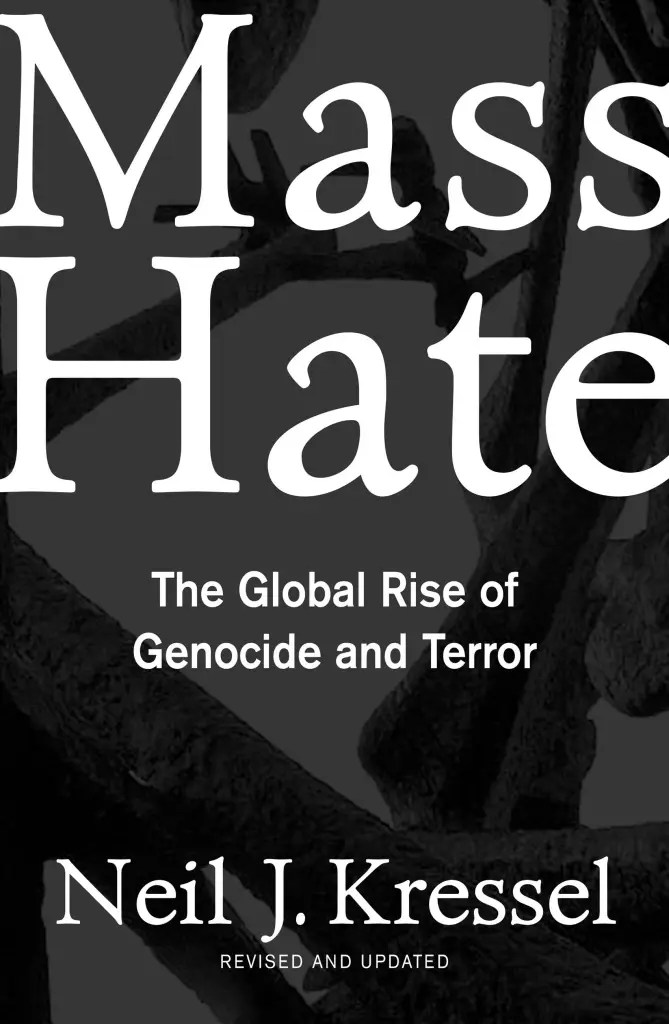
Revised and updated for Perseus / Westview, 2002
Current Publisher: Basic Books / Hachette Group
What people are saying
“Kressel has a jeweler’s eye for deflating grandiose conjecture, especially when tainted by ideology. . . On Nazi Germany he is especially strong. . . This book is a superb review of the literature on mass hate. Kressel is free of bias. He treats landmark research — from Hannah Arendt’s ‘banality of evil’ thesis to the obedience studies of Stanley Milgram — respectfully but not reverentially. It is easy to develop confidence in the author’s discernment.”
The Washington Post: Book World
“Neil Kressel’s book is a masterly analysis of . . . [the] problem and of how the new tide of mass hatred around the world might best be turned back.”
Brian Urquhart, Former Under Secretary General of The United Nations
“Neil Kressel has written a book that is frightening in its implications and comprehensive in its documentation of the human impulse to hate and to act murderously.”
Frank R. Lautenberg, United States Senate
“Anyone interested in understanding the genocidal massacres and terroristic violence of our time should read Neil Kressel’s illuminating and highly intelligent book in which he exhibits great analytical acumen and a thorough mastery of social psychological theory.”
Erich Goldhagen, Harvard University
“His prose is moving and accessible, without in any way minimizing the complexity of the issues. Mass Hate helps us understand the darkest recesses of human nature. By bringing light to darkness, it offers hope for a better future.”
Jeri Laber, Human Rights Watch
“With the decline of Marxism-Leninism as the overriding evil in the world, Americans need guidance to understand the proliferation of lesser plagues. Neil Kressel provides just this in his well-researched and well-written survey; better yet, he comes up with thoughtful recommendations for reducing mass hatred.”
Daniel Pipes Editor, Middle East Quarterly
“. . . his intellectual and ethical effort is admirable.”
Dan Bar-On, Aggressive Behavior
“. . . a major work on the topics it addresses. . .”
Stephen Schwartz, From West to East
“Each spring, I teach an honors undergraduate course entitled “The Social Psychology of Good and Evil,” and I have placed these two books high on the reading list. Mass Hate is near the top; for reasons noted below, The Heart of Altruism is a bit lower. . . [T]he language is simple and direct. . . Kressel tells each story well and documents it thoroughly.”
Sam McFarland, Political Psychology
“. . . an excellent synthesis of the literature. . . Notably, it is one of the very first to incorporate material about contemporary political and fundamentalist Islam into its treatment of mass hatred, genocide and terror.”
Eugene B. Brody, M.D., Editor-in-Chief of The Journal of Nervous and Mental Disease
“. . . an illuminating psychosocial inquiry into the roots of mass hatred. . .”
Publishers Weekly
“He illumines much, understands much, and explains much. His questions are profound, his concerns urgent. Kressel’s conclusions are modest and therefore more honest than other more pretentious works.”
Michael Berenbaum, Director, United States Holocaust Research Institute
“I only wish this book could be put into the hands of heads of state and diplomats around the world.”
Alan Caruba, Bookviews
“. . . an insightful study. . . Many will question Kressel’s conclusion that the best protection against mass hate remains the establishment of democratic societies and the protection of individual rights. However, such claims are trivial in light
of the wealth of evidence the author provides.”T . M. Chester, Choice Magazine
“Not since Wilhelm Reich’s Mass Psychology of Fascism has there been anything as penetrating on the subject. Neil Kressel’s analysis of stereotyping and ethnocentrism, and their terrible consequences, both in the past and present, is arresting, frightening, and convincing.”
Larry McMurtry, Author, Lonesome Dove
“. . . Mass Hate is very well suited as a springboard for lecturing in undergraduate social psychology seminars. . . Mass Hate is a good book and worth reading — especially for those unfamiliar with the literature on authoritarianism and genocide.”
Mark P Worrell, Sociological Inquiry
“This important book explores the behavior that has made this century the most genocidal in our planet’s history. . . The author has mastered much of the literature on the subject of terrorism and genocide and devotes the last two chapters of his book to challenging some of the more important theorists on the subject, including Hannah Arendt on the banality of evil, Theodor Adorno on the authoritarian personality and Stanley Milgram on obedience to authority .”
Jack Fischel, Millersville University
“Dr. Kressel brings great mastery of the elaborate nuances of evidence and interpretation to all of his subjects, whether they be his case studies of Bosnia, Rwanda, New York City Muslim terrorism, or the Holocaust.”
Tim Starr, Free Life
“. . . this is an informative and intelligent book. It is especially useful in understanding the background to the genocide in Rwanda and violence arising from a form of extreme Muslim fundamentalism, which to my knowledge have not been previously explored in the psychological literature.”
Ervin Staub, Contemporary Psychology
 Neil J. Kressel