About the book
A new – and largely hidden – profession has emerged during the past three decades. Drawing on the techniques of modern social science, psychology, and market research, its practitioners seek to remake the way we pursue justice in the United States. Trial consultants help lawyers to pick — some would say, stack — juries predisposed to render the “right” verdict. And consultants apply sophisticated research methods to predict how jurors are likely to respond to arguments, witnesses, and evidence. Based on the results of the research, they craft case strategies, help to prepare witnesses, and test and retest arguments — all before a single word is uttered in open court. For fees that sometimes approach six, or even seven, figures, the new jury experts offer attorneys and their clients what they most desire — a way to remove uncertainty.
What are we to make of this new industry? Do the techniques work? Is this, as some critics have argued, a new form of high-tech jury-rigging, not much more acceptable than cruder forms of jury tampering? Or do the methods of jury consultants amount to little more than an extension of what attorneys have always done?
One thing is clear. The profession is growing steadily. Jury consultants have already made their mark in big-money civil cases. And they have played key roles in prominent criminal trials. After hearing jurors acquit in the O. J. Simpson case, the first person thanked by defense attorney Johnnie Cochran was his jury expert. The burgeoning of the trial consulting industry seems destined to continue. During the past few years, firms have started to offer low-cost consultations, sometimes conducting research for as little as 2000 per case. For better or worse, the wares of the trial consultant are now within the reach of many who previously deemed them too expensive. When a new trade roams the halls of our legal system, aspiring to change America’s road to justice, we had all best pay attention.
This book will reveal the “tricks of the trade” and explore the many ways in which trial consultants have infiltrated the courtroom. The authors — a social psychologist and an attorney — present cases where consultants arguably have been responsible for huge jury awards and controversial criminal verdicts. However, it is not their purpose to launch an all-out attack on this growing industry. Instead, they aim to pull back the curtains, allowing a fair and balanced assessment of a new phenomenon in American justice. To achieve this objective, the authors must address issues that lie at the very heart of the American jury system. Are juries fickle? Are they easily swayed? Are jurors influenced — as many have charged — by their age, gender, race, ethnicity, occupation, intellect, personality, or politics? Here, the authors sort through the work of many jury researchers, arriving at conclusions that are balanced and credible. They conclude with sensible and far-reaching proposals for change.
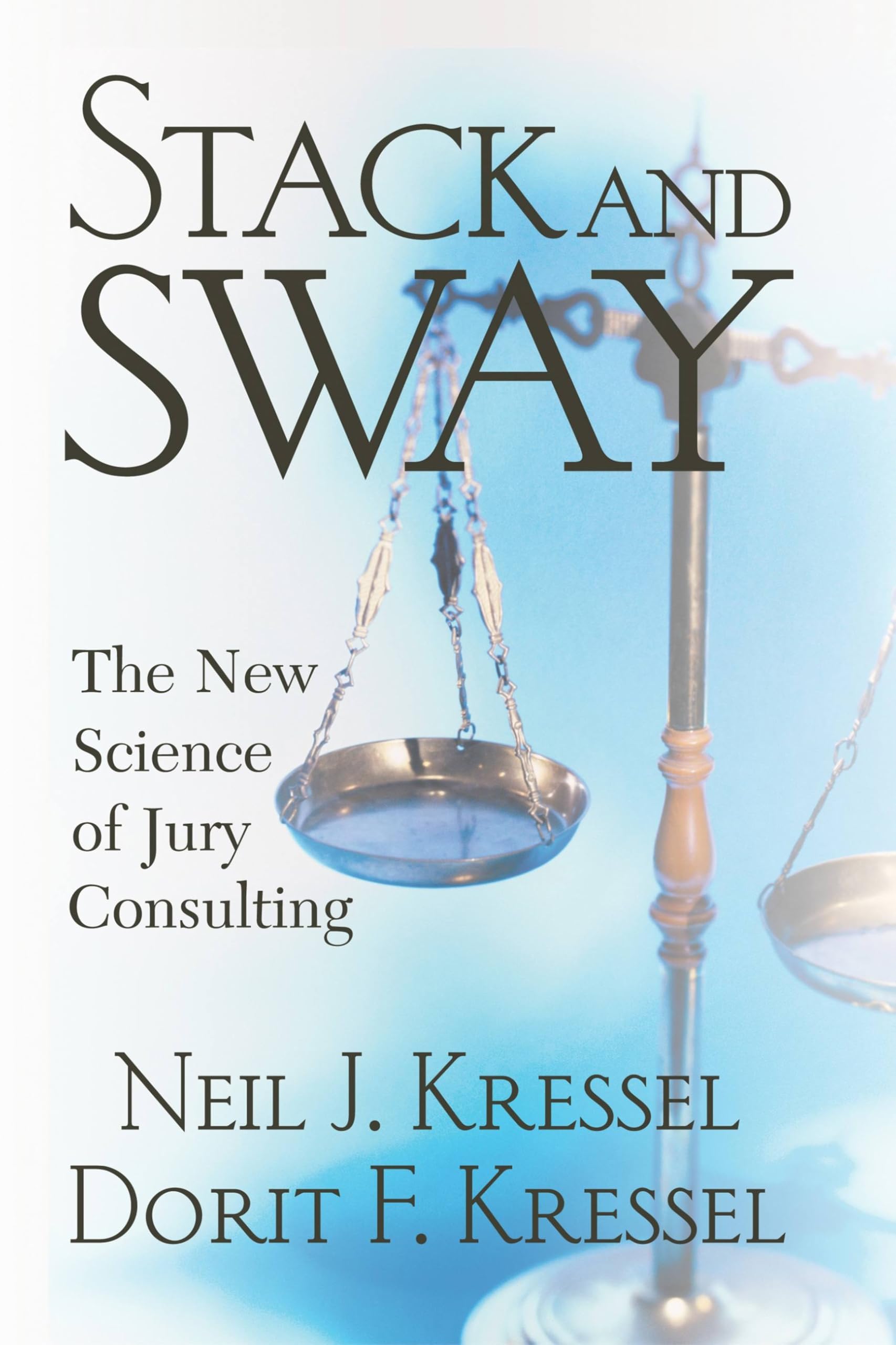
Current Publisher: Basic Books / Hachette Group
Book Details
HARDCOVER
9780813397726
PAPERBACK
9780813342412
Buy the book
What people are saying
“Anyone who is involved with, or interested in, trials by jury, either civil or criminal, must read “Stack and Sway”. Neil and Dorit Kressel not only explain the hidden power of jury consultants, they raise troubling issues about the very nature of the jury system itself. They made me realize that ‘how much justice can you afford’ no longer applies only to lawyers.”
Dick Wolf, Creator and executive producer, “Law and Order”
“Readers interested in a carefully researched examination of this influential but largely hidden growth profession will find it in Stack and Sway . . . [This] surprisingly engaging book provides an even-handed accounting of the methods and madness of this relatively new phenomenon, and the possible implications for American justice. Best of all, it manages to do so without being preachy or simplistic. Indeed, the book’s real fun lies in the Kressels’ admirable habit of presenting from opposing angles the various issues raised by the panoply of services which jury consultants so enthusiastically provide.”
Dorothy Samuels, Member, New York Times, editorial board, The Washington Monthly
“Wide-ranging, carefully researched, well-written and very timely: agree or disagree with its conclusions, this book could scarcely be improved on as an overview of what jury consultants do and why their role in trials has come to be so controversial.”
Walter K. Olson, legal scholar, Manhattan Institute, Author, The Excuse Factory and The Litigation Explosion
“Stack and Sway: The New Science of Jury Consulting is a delightful rarity: . . . an intrinsically interesting topic, levelheaded scholarship, and a socially important issue. I recommend it to anyone who is interested in the American jury system.”
Reid Hastie, Professor of Behavioral Science, University of Chicago
“The lesson of these two fine books is that, like democracy, in its own messy way, the jury somehow works.”
The Economist magazine, a review with D. Graham Burnett’s A Trial by Jury
“. . . a well-researched, lucid, and fascinating look at the business of jury consulting. . . Recommended for general collections.”
Harry Charles, Library Journal
“The comprehensiveness in treatment of issues and players is commendable, and no one interested in jury work should miss this tour de force. . . . Chapter 6, Blacks and Whites in the Jury Box, is a gem.”
Dr. Gary Moran and Dr. Brian Cutler, JuryTactics in ASAP: Analyses of Social Issues and Public Policy
“This is a book that needed to be written. . . Kressel and Kressel cut through the puffery and myth surrounding trial consulting and fairly and competently evaluate what jury consultants can and cannot do. They candidly discuss the ethical issues in the trial consulting business, consultants’ potential effects on the fairness of trials, and the implications of trial consulting for the jury’s place in democratic theory.”
Neil Vidmar, Ph.D, Russell M. Robinson II Professor of Law and Psychology, Duke University
“Stack and Sway is an interesting book that discusses what might otherwise appear as arcane, namely, the so-called profession of jury consultants. . . . The book is very readable and well supported.”
Steven M. Richman, Esq., a New Jersey Lawyer
“This book, written by a psychology professor and a lawyer, delves into the practice of jury consulting and examines its effects on trial practice. It is well written and enjoyable. . .”
Professor Edith Greene, Judicature
“. . . a thoughtful account of jury consulting set in a general depiction of the jury trial. . . As an engagingly written work based on interviews and substantial research literature, it is excellent for the general reader or as a supplementary text in an undergraduate judicial process course.”
Professor Marvin Zalman, Criminal Justice Review
“This book will satisfy many different audiences. . . One of . . .[its] best attributes is its readability. . . The authors treat the subject matter in a highly objective and unsensational manner, even though it would have been easy to do otherwise. Their reasoned approach is convincing to this reader.”
Professor John F. Kozlowicz, Law and Politics Book Review
“. . . an excellent source of detailed research documentation on jury consulting techniques and approaches.”
C. Michael Hausman, Wisconsin Lawyer
“. . .a thoughtful study of the jury consulting business, which does not quite manage to allay . . .[our] fears entirely.”
Dennis Hale, Transaction/Society
 Neil J. Kressel